
Knocking on Doors in the Age of AI: Prabhath Isn't Convinced
This article was written automatically by converting Praveen's recordings to text through JustThoughts.
I'm a doctoral researcher studying occupant behaviour, and in my final year I'm running post occupancy evaluations the hard way: by walking into people's homes. This post grew out of conversations to and from the gym with a genius computer scientist friend who keeps asking why I don't just use AI. It's about privacy paranoia, the fear of AI, and whether we're really saving the planet by avoiding both.
Introduction
- Post occupancy evaluation in residential buildings means on-site visits, interviews and observation, and each visit brings fresh challenges.
- A computer scientist friend keeps asking why these problems can't simply be automated with AI.
- AI tools are fast, consistent and reliable, and excel at turning known unknowns into known knowns.
- Privacy awareness campaigns create knowledge but not understanding, making participants reluctant and fearful.
- People will share medical data with a chatbot but hide their address from a researcher, which is itself an argument for AI-mediated studies.
- Anti-AI campaigning echoes old energy-saving campaigns that led people to sit in the dark and lose more than they saved.
My PhD is interdisciplinary, and what I study is how occupant behaviour affects indoor environmental quality and the resource efficiency of buildings, or building performance more broadly. These days, in my final year, I'm conducting post occupancy evaluations.
There are different ways of doing post occupancy evaluations, and I chose the hard way: on-site investigations. I focus mainly on residential buildings, because there is far more freedom in occupant behaviour there and the complexity is very high compared to non-residential buildings. So I go to the houses of my participants, conduct interviews, take observational notes and so on. Every day when I come back from a house, I have so much to type up and so much to think about. There are so many challenges with every house, and with finding participants in the first place.
The gym conversations
Today's post isn't about myself or my research background. It comes out of a discussion with a genius about the daily challenges in my post occupancy studies. I go to and from the gym with Prabhath, a genius computer science postdoctoral researcher and a friend of mine. We start gossiping as usual, and then things about my post occupancy evaluations and their challenges slip out of my mouth all the time.
This genius computer scientist always argues: why can't you avoid these things? Why can't you just use some technology? Why can't you use AI? Don't you find any alternative methods? Why do you need to go to someone's house? It might sound offensive or negative, but if you have ever dealt with a very clever computer scientist, you'll know those people think very rationally and they know how to get things done. If something works, it works. That's how most of them think.
Every time I explain the challenges, he humorously trashes my complaints. He says there should be answers to all of these problems, that I'm just getting into problems and enjoying problems and never actually wanting to solve them, and that if I wanted solutions, there must be solutions out there.
 (Walking back from the gym with Prabhath, where most of this argument actually happens)
Two fears pulling in opposite directions
The biggest problem I face is people being paranoid about their privacy, and alongside that there is the scientists' fear of AI. It is a tug of war. Are we really saving the planet? People fear technology and worry about privacy. Researchers fear AI for many reasons, which I'll come to later.
First, I'd like to talk about how we can use AI to help with anything related to buildings, since that's my area. You can do post occupancy evaluations with different intentions and in different modes. But today everything is different, and I think most of the problems we have with getting entry to houses can be solved with technology, mainly artificial intelligence, even though it's a buzzword you hear all the time.
The most important thing is that any AI tool is far more efficient than a human being. They can do things much faster, more efficiently, more reliably and more consistently than a human could ever imagine doing. I know that from practice. I also know some people hate AI and won't even give it a try. Some have never properly tried any AI tool; they probably tried the first version of ChatGPT and nothing since. From my personal experience, I know how consistent and reliable these tools are. You can toss a set of problems at them, or something very complicatedly tangled together, and it will always give you back an untangled solution. That's how miraculous AI is.
I mainly work with natural language processing and large language models, and I'm really fascinated by the capabilities of today's natural language processing, with all the multimodal technologies that come with it.
Known knowns, known unknowns, unknown unknowns
Beyond efficiency, reliability and consistency, what strikes me is how effectively these tools turn known unknowns into known knowns. Known knowns are the things you know that you know. Known unknowns are the things you know that you don't know. The third type is unknown unknowns, the things you don't even know that you don't know, the things that suddenly appear in your life when you read a book or simply stumble upon something you never knew existed.
I think any artificially intelligent tool, whether it's computer vision, natural language processing or anything else, is really very good at turning known unknowns into known knowns. You almost always know what to expect from these tools, and you get it. What is more fascinating, and what gives us the reward, is how fast they return those known knowns. You explain what you want and you instantly get it. That instant reward is something really fascinating.
What I actually mean by automating this
So when I say we can automate most of the things about post occupancy evaluations, or improve the indoor environment, or contain energy efficiency or resource efficiency in a house, using AI, what I mean is this. There are so many things that can be done numerically, numeric things with equations and maths, where technology is excelling anyway. And there are so many things we can also solve with natural language processing, because as I've said before, not everything about a person or their personality can be explained with linguistics, but there is so much that can also be explained with linguistics.
So when we use natural language processing, we can understand people's attitudes and traits. If you have data collected over a long period, behaviour, what people discuss using these big tech apps, or the information collected through phones or smart home systems, we can use all of these technologies together: natural language processing, computer vision, voice recognition, and all of these together to provide magnificent outputs.
Let's say in a house there are different systems: windows, heaters, mechanical ventilation systems and all the other devices, and there are people. We can get information about devices from the internet, so let's say there is a smart home system and an app on the phone. On this app, occupants can input all the different systems they have, maybe as images. If they attach them as images, we can extract data from the images using computer vision, and then identify all the different systems in a house, where they are spatially arranged, their functionality and their structure and everything.
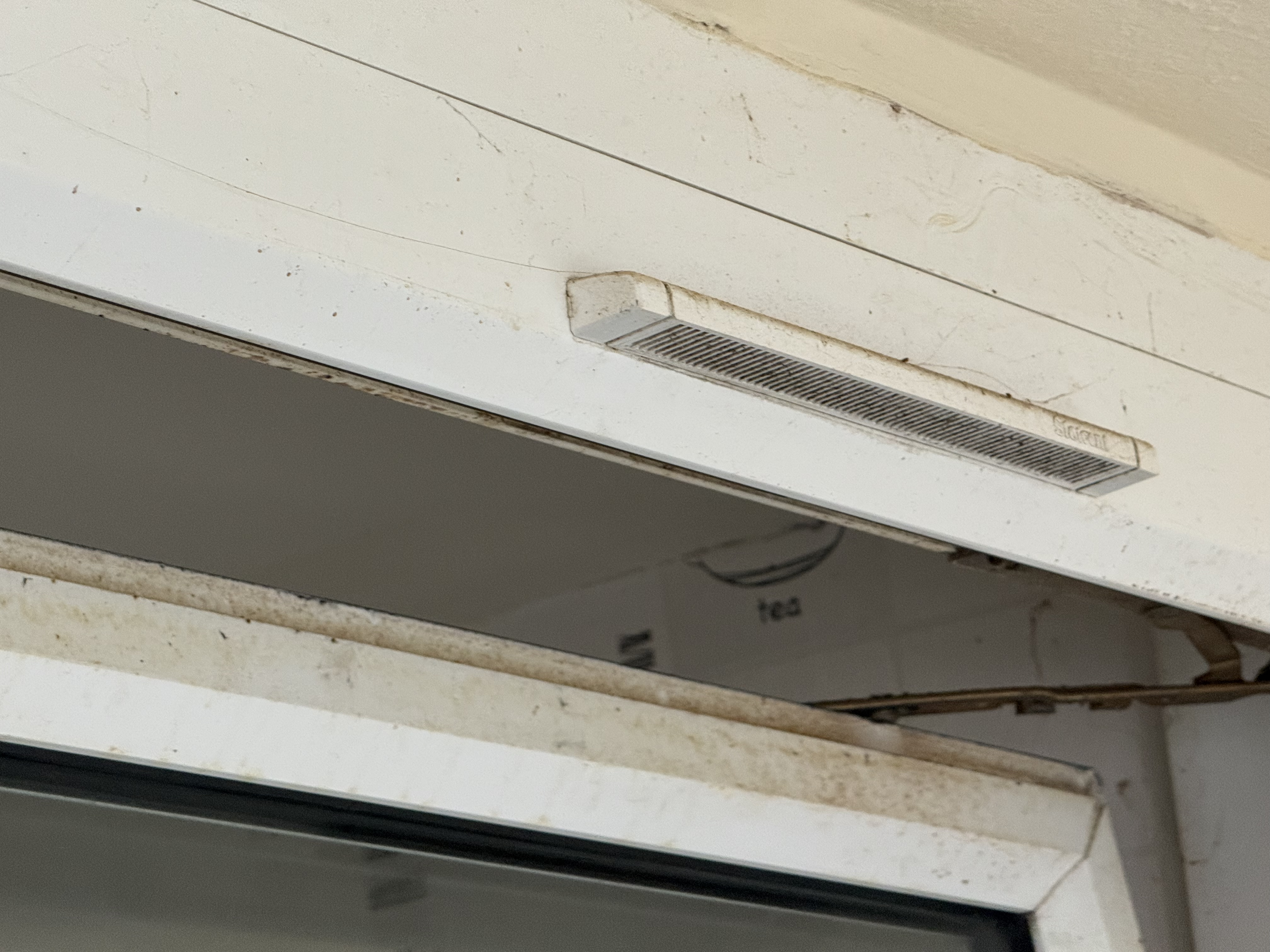 (This is exactly the kind of detail computer vision can pick up precisely: a blocked or dust-caked vent like this one, which quietly undermines ventilation long before anyone notices a problem)
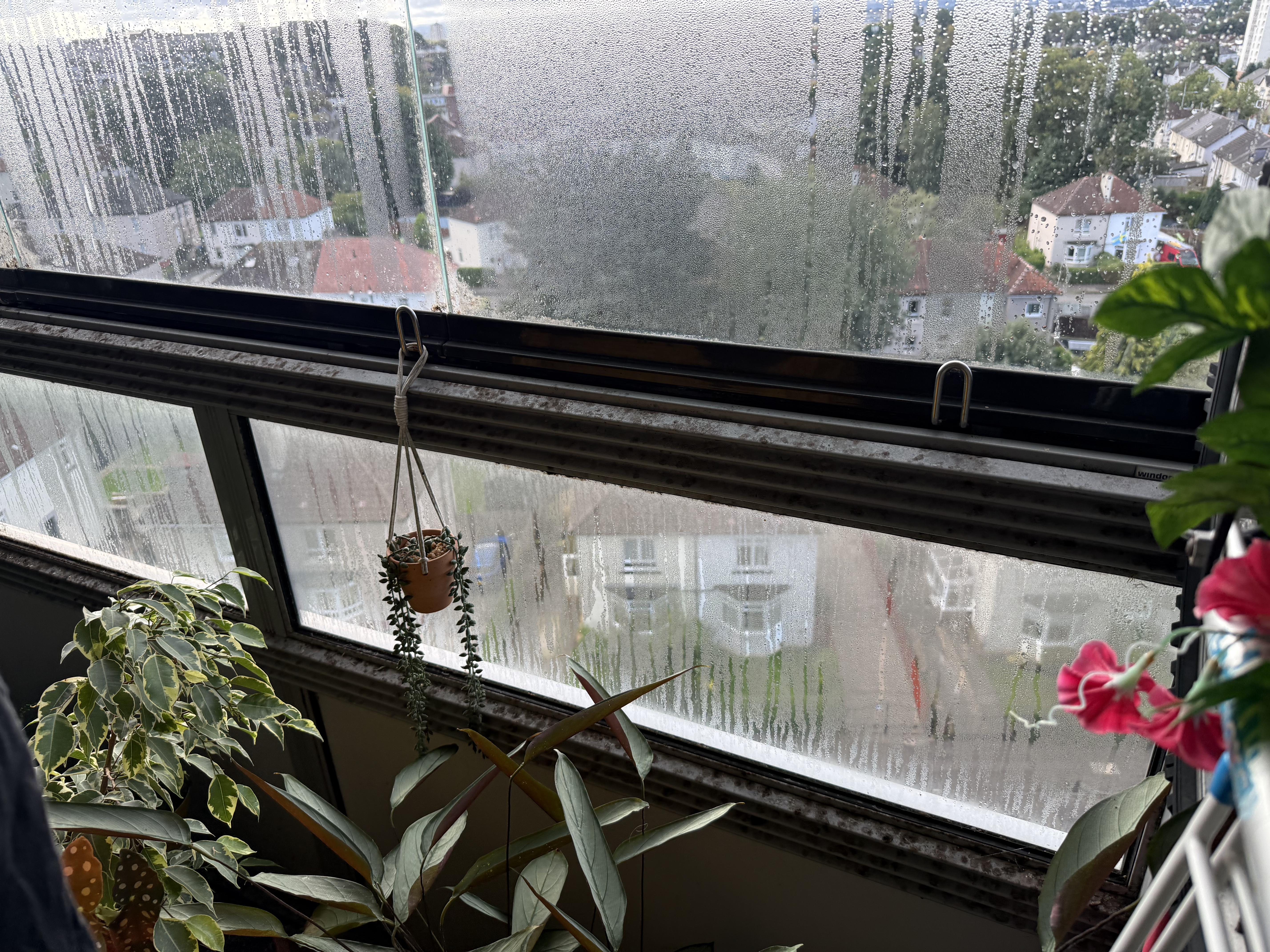 (Same with moisture on glass like this: an occupant might not think to mention it, but a photo is enough for computer vision to flag the condensation and what it says about ventilation and humidity in the room)
Combine that with natural language processing reading how occupants describe their home, and you get a picture no single method could build on its own: precise physical detail from the images, and behaviour and attitude from the language.
And then about the people: when people interact with the smart systems, when they talk with these things and request different things, you can save all this private data. With this data you can definitely learn about the people, so it can be seen as unethical, but if you are using it for good intent, to improve the living conditions of a house, it can be ethical. So you can use AI for that as well. When you know about the systems, when you know about the people, when you know about the neighbourhood from satellite data or whatever APIs are available, you know pretty much everything about the house in a systems way. So why can't we just solve all the problems?
It can be used in many ways: to alert people about adverse situations and help them improve their conditions through awareness, maybe suggest they buy equipment like purifiers, maybe suggest they update their ventilation systems, and so on and so forth. So I don't see, in the future, someone going to a house and exploring the living conditions of someone manually, because these can be integrated into assistants and technological systems.
Do I even need to enter the house?
In my domain, I know I probably don't need to go into houses to see what factors affect behaviour, what influences the indoor environment, what influences resource consumption, and how we can inform effective behavioural interventions. Those kinds of investigations can be automated very effectively and reliably. We just don't need to go into houses.
The easiest and most ethical option is to integrate an AI agent into a smart home system or a smartphone. It can interact with the occupants, create awareness, gather insight from them, process it locally for higher privacy, and even suggest good interventions to improve building performance. AI has real potential here, and I'm very positive about it.
Most importantly, I think there's nobody better placed to solve this problem than the big tech companies. Some people will say it isn't ethical, but I don't see a problem. They already hold enough information about pretty much every person on the planet. Using that information, I don't think there's a need for a researcher anywhere in the world, unless the context is not that developed in terms of technology, to go into a house or conduct a survey about indoor environmental quality and resource consumption. The big tech companies have access to all of this data: personality traits, attitudes and behaviours, the different challenges people face every day, medical data, environmental data. In a few years people will be adopting all sorts of sensors and connecting them to their Apple, Google or Amazon ecosystems, and those companies will hold the data.
So I don't see the point of a researcher from any university conducting a survey. There's no point; it's just entertainment. I want to highlight that term: it's just entertainment. It's just us circulating money in the economy because everyone has to do something. Otherwise, these problems can be solved by the tech companies. I also think using AI could provide better privacy, because if this data is to be used ethically, AI agents or robots may well be more ethical than real people handling it. Real people are very unpredictable and uncertain.
Awareness without understanding
Now back to privacy paranoia. People these days have a really big fear about their privacy, because there are so many awareness programmes on the internet and in real life explaining the importance of privacy and data protection. On one side that's good: there are many non-profit organisations, universities and individuals trying to protect people from losing their privacy.
But there's a bad side too, because they are only creating awareness, not understanding. They create awareness and knowledge, but it never reaches understanding. People should understand that sharing your information isn't always bad for you. It can sometimes be a good thing. When you go to a doctor, hiding things from them is not wise. It's not good to share your medical letter with any random person or with your friends, but ideally you should share everything with your doctor, and in a lawsuit with your lawyer. Those are the things people should know.
On the internet, with AI or with university researchers, people are very reluctant to share their information. That's why it is so difficult to find participants for a university research thesis: there are so many campaigns highlighting the importance of privacy that people passively accept the message and ignore anything that asks for their information.
And yet, it's actually rather dumb, if I can put it that way, that people don't think twice about putting their information into ChatGPT or any AI agent they use. They put in medical information, personal photos, everything. They trust these AI tools completely, but they don't trust real people. From one side that's understandable, and it was genuinely a challenge for me to find participants because people are more conscious about privacy.
But there's one more thing. People don't mind sharing information with an AI agent, because it has no real connection with them and it isn't a living being. In real life, they think they'll be judged by the researcher or treated differently if they share their original thoughts and are honest with us. So they either decline interviews or hide most things and make things up when we ask questions. That is also an advantage of using AI: people trust AI more than they trust real people.
One participant, many fears
From my experience, I invited someone I know to take part in my investigation, and they said they didn't feel comfortable because I would come to their house and ask questions. This person wasn't living in the fanciest house, and they thought it wouldn't be nice for me to see their living conditions. So they declined.
Later on they agreed and let me come and do the investigation, but they said they didn't want to share their address with me. They thought I might pass the information on and that their social housing provider or housing group would cause problems if anything wrong in the house was identified through my research. So they told me to come to a particular place and then drove me all the way to their home. They never told me the address, and asked me not to include anything personal, even though I never intended to.
Then the same person had many problems with my air quality sensors. These sensors only collect temperature, humidity and carbon dioxide levels. But this person kept calling me from time to time asking what the sensors were doing, whether they emit any rays, whether they could be harmful, how much energy they consume, whether I was monitoring them, and so on. I think that's because these people live in fear. They're afraid of technology because of the campaigns online.
In a very libertarian approach, if that's the correct word, if you try to make everyone happy then you can't help anyone. All of this research is aimed at improving the condition of their homes, in my domain at least, and in other domains researchers are trying to improve conditions across the whole world, to make everything sustainable and good for everyone. When people aren't supportive on the other side, you can't help them. This privacy thing is going to a very bad extent.
The fear of AI among researchers
The other side is the fear of AI, or the reluctance and discouragement around using it, from researchers themselves. Most researchers are very concerned about sustainability and saving the earth. I see a lot of my colleagues who work in sustainability creating awareness about how much energy AI models consume and why you should avoid using them, including AI image generators and everything else.
There are different concerns. One is the environmental impact of AI. One is privacy. One is that the money goes to the USA, and some people hate the USA by default, so because of that they tend not to use AI and they always encourage others not to use it. There are so many stereotypes around hating AI these days.
I think there are many advantages to using AI, and many ways AI can help save the earth, make things sustainable, help with health and well-being, and help in other sectors like education. I see so many benefits. But people are getting caught up in campaigns or propaganda against AI, and I don't think that's a good thing.
Isn't it the same as a few decades ago, when there were so many campaigns encouraging people to save energy? Everyone wanted to save energy, and everyone was asked to turn off lights when they weren't in use. Some people took the awareness without turning it into understanding, and reacted passively. They turned off all the lights and sat in the dark or with a very insufficient amount of light. You know how bad that can be: people work in poorly lit areas, and it affects their productivity, their vision and so many other things. In return you save a little bit of energy and lose a lot of productivity.
The sustainability case for AI
I think the same applies to AI. From my personal experience, I have processed documents with AI in five or six minutes that would otherwise have taken me a few months to do manually. I know AI can't do everything. I don't think AI can turn unknown unknowns into known knowns or known unknowns. But AI can do miracles, especially with natural language processing. It's on a different level.
It can also save a lot of energy and be more sustainable than real people. Take the thing AI did in five minutes that would otherwise have taken me a month. Imagine how much I would have emitted by travelling to the office and using the office air conditioning, lighting and computers, just to do that small thing. Isn't AI more sustainable?
What people always forget is that these models consume enormous energy and resources for training, but once trained they consume a very tiny amount of energy. We'll have to sacrifice in the beginning, but hopefully in the future, once most of these models are developed, we will save a ton of energy.
Closing thought
So here we've spoken a lot about the tug of war between AI and the propaganda against AI, the fear of privacy and people being paranoid, and different things in a systems thinking way. I'm a very positive and proud systems thinker, and I'm grateful to be able to bring together many people with different views. I have colleagues who are against AI, colleagues who are very positive about it, and colleagues with views in between. It was a great discussion, and I thought it was really important to share with everyone.
Thank you so much.
Most powerful idea: The most striking idea is that an AI agent embedded in a smart home could be both more ethical and more trusted than a human researcher, because people will confide in a non-living system what they would never admit to someone standing in their living room.