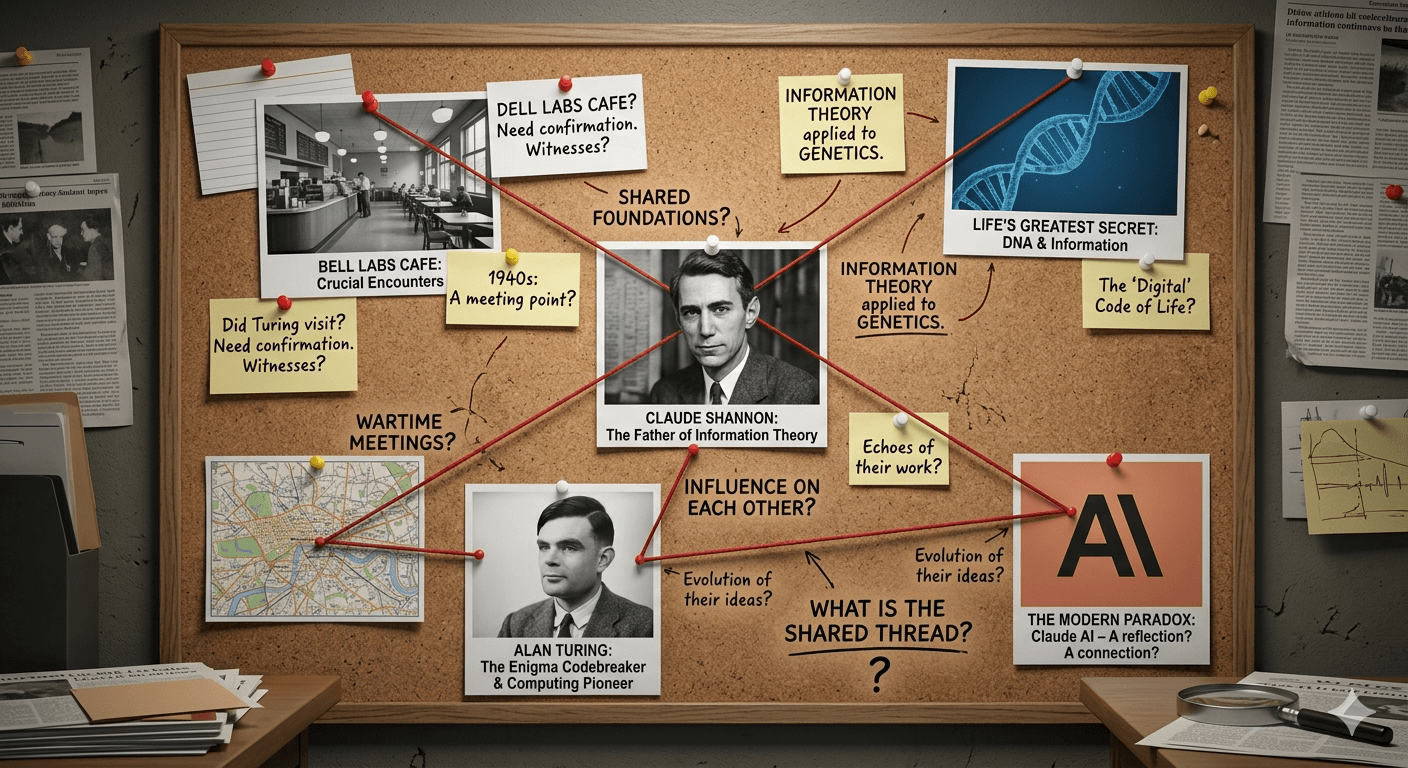
Who is this Claude?
Introduction
This is about a Claude I met in a book I was reading this evening - it made me go and search that name immediately, and this is what I found. The book was Life's Greatest Secret: The Race to Crack the Genetic Code by Matthew Cobb.
Life's Greatest Secret
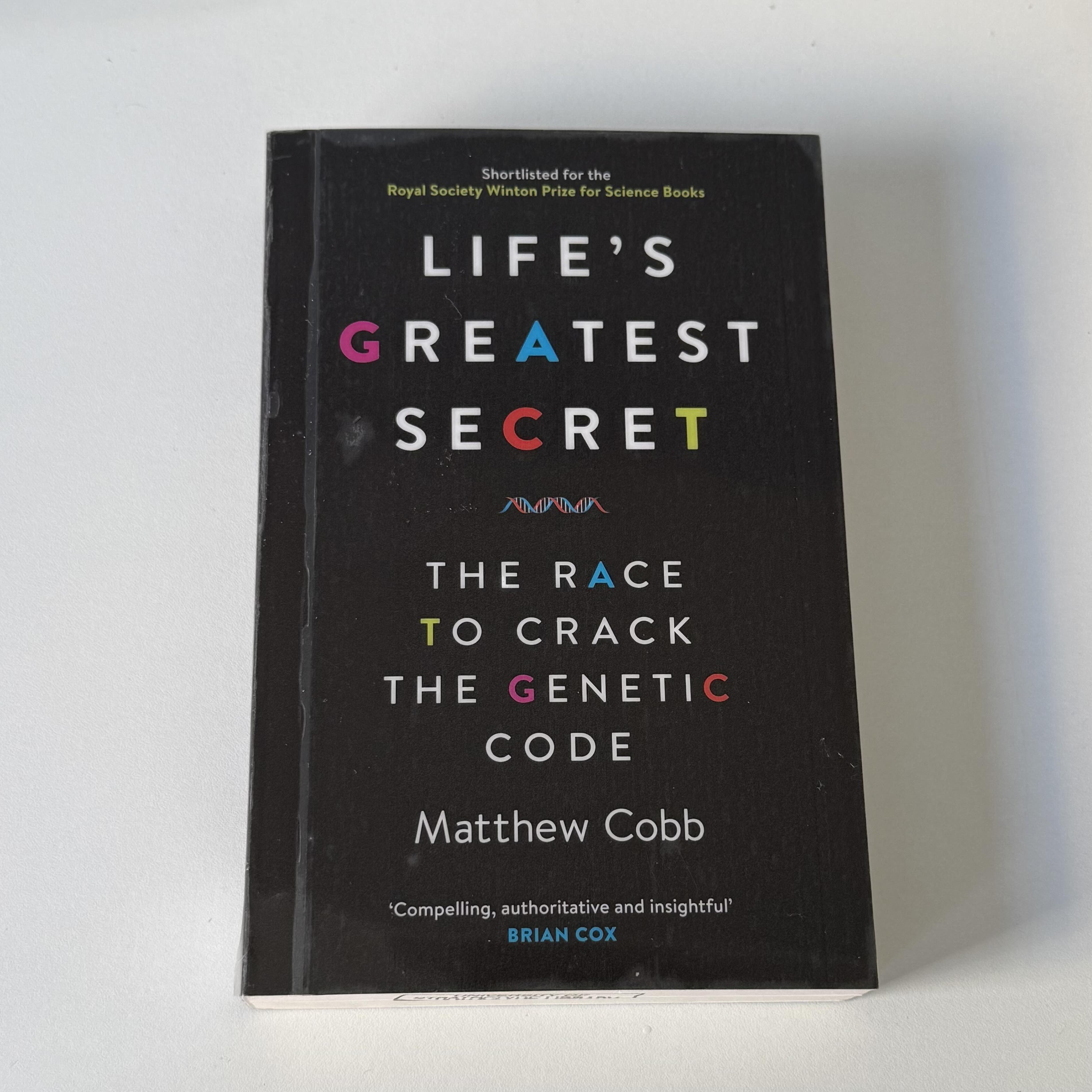 (Life's Greatest Secret Book by Matthew Cobb)
This is a book I found whilst searching through the university library for books on Cybernetics and Information Theory. Matthew's book starts with the best literature on genes and DNA that you'd ever find. Erwin Schrödinger's explanation that life survives 'by continually sucking orderliness from its environment' was the best quote in the beginning, though his work was later critiqued by many scholars, including Nobel winners. If you wonder what that means, you probably need to go find this book and read!
This book further talks about something that stopped me mid-page, the uncanny parallels between how we code computers and how nature codes life. Cobb explores how the discovery of the double helix wasn't just a win for biology; it was a win for information science. The scientific community, he details, began to realise something extraordinary: DNA isn't just a molecule. It's a script. It's the ultimate hard drive, storing the instructions for all of life itself using a four-letter alphabet — A, C, G, T — that functions remarkably like the binary code Shannon was quietly obsessing over in his Bell Labs office at the very same time.
And there were so many interesting stories that I don't want to spoil here. If you want to understand how "information" became arguably the most important word of the twentieth century, you probably need to go find this book and read!
Another MIT-trained mathematician
This is the most interesting part. On page 25, I read: "Another MIT-trained mathematician called Claude E. Shannon was working on similar problems at the same time…" Wait a minute, who is this Claude?
I immediately went and searched what you would probably do too: "Did Anthropic name their model after Claude E. Shannon? If so, who is he?"
Claude answered: "No, Anthropic has not officially stated that Claude is named after Claude Shannon. The name's origin hasn't been publicly confirmed."
A Conversation at the Bell Labs Cafeteria
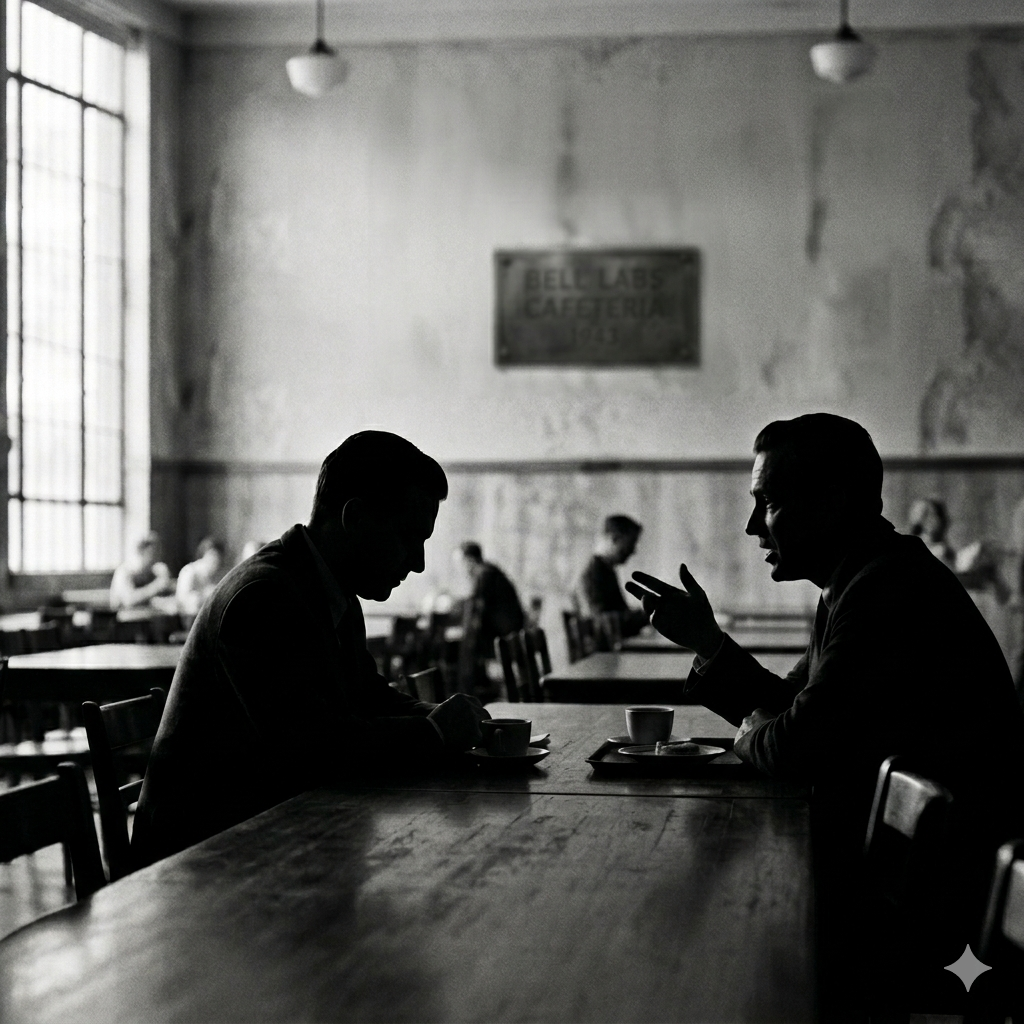 (An AI generated image of the conversation happended at the Bell Labs cafeteria)
This is the next time I see Claude in this book:
Location: New York City
Time: 1943, during the height of World War II
Although Turing did not work with Shannon, the two young men regularly had tea together in the cafeteria, where they discussed:
Turing: I've been thinking more about this "Universal Machine," Shannon. A device that, in theory, could perform any conceivable calculation. Just imagine, a singular Brain for even the most complicated sums!
Shannon: You know, Alan, I think such a 'Brain' would be capable of more than just sums.
Turing: More than sums? What do you mean?
Shannon: I want to feed not just data to a Brain, but cultural things!
Turing: Cultural things?
Shannon: Yes. I want to play music to it!
(I turned the text into a dialogue, all rights to the original author)
Here, as soon as you see 'Universal Machine', what comes to your mind is Claude. Not Shannon's Claude - Anthropic's Claude, the one that does miracles today. Isn't it?
Claude Elwood Shannon
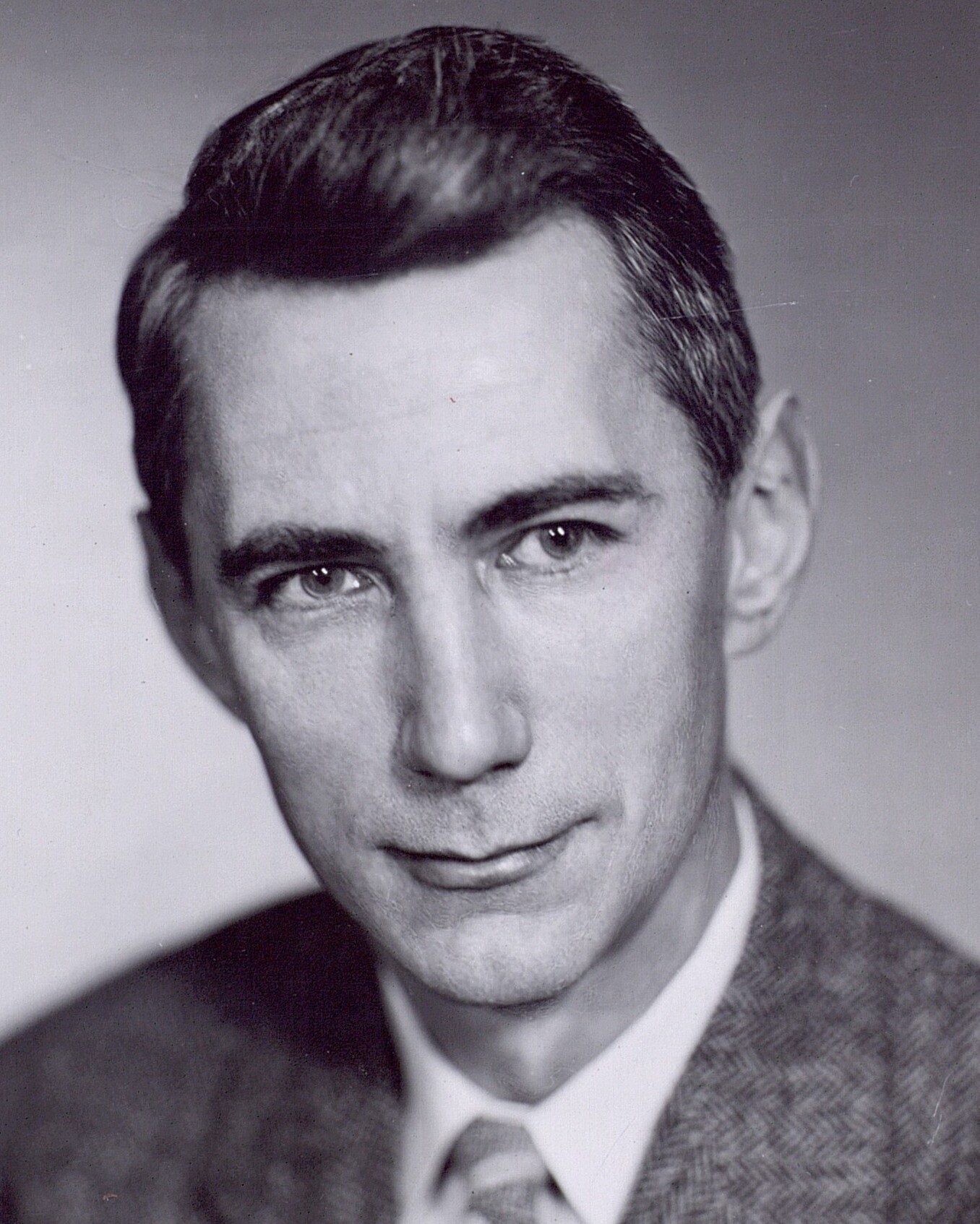 (Claude Elwood Shannon (source: Wikipedia))
Let's first start with Shannon.
Claude Elwood Shannon (1916–2001) was an American mathematician, electrical engineer, and cryptographer whose work fundamentally shaped the modern digital world. Often called the "Father of Information Theory", and sometimes the "Father of the Digital Age", Shannon's ideas underpin virtually every form of digital communication we use today.
Born in Gaylord, Michigan, he studied at the University of Michigan before completing a legendary Master's thesis at MIT in 1937, widely regarded as one of the most important theses ever written. He spent most of his career at Bell Labs and later as a professor at MIT.
Key Achievements
- Founded information theory with his 1948 paper A Mathematical Theory of Communication
- Invented the concept of the "bit" as the fundamental unit of information
- Demonstrated that Boolean algebra could be applied to electrical circuits, laying the groundwork for digital computing
- Developed Shannon's entropy, a measure of uncertainty in information systems
- Pioneered early work in cryptography, artificial intelligence, and chess-playing machines
Awards & Honours
- Alfred Noble Prize (1939)
- IEEE Medal of Honour (1966)
- National Medal of Science (1966)
- Harvey Prize (1972)
- Kyoto Prize (1985)
- Claude E. Shannon Award, named in his honour by the IEEE Information Theory Society
Beyond his academic work, Shannon was famously eccentric, he juggled in the corridors of Bell Labs, rode a unicycle, and built peculiar mechanical contraptions for fun. He died in 2001, largely forgotten by the general public, though his fingerprints remain on every digital device in existence.
Alan Turing
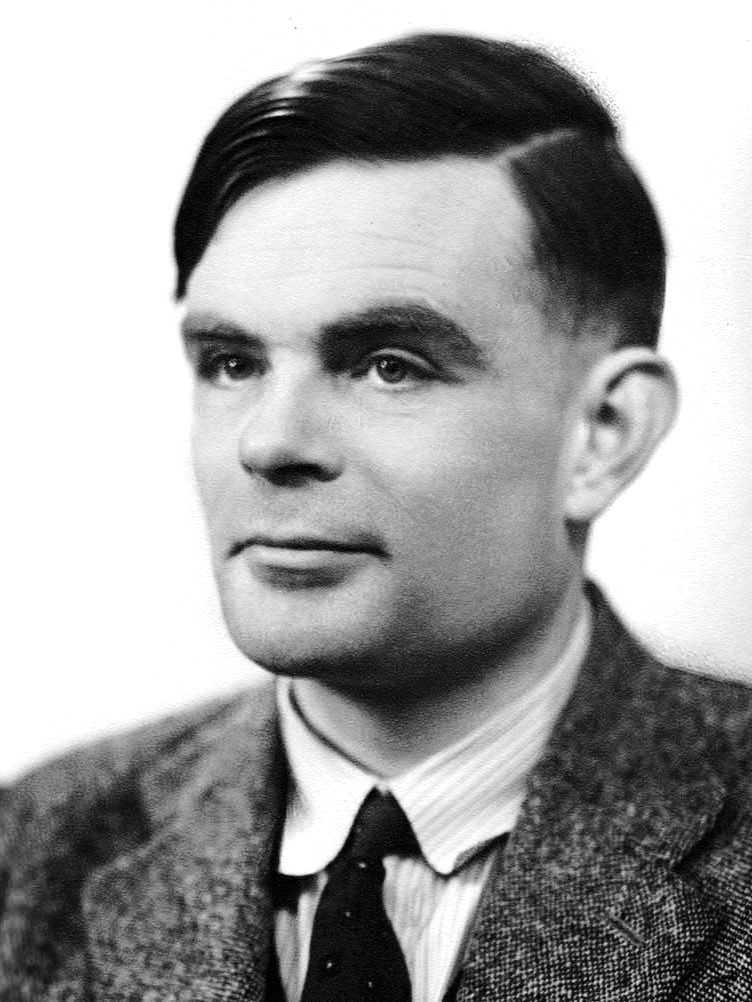 (Alan Turing (source: Wikipedia))
Alan Mathison Turing (1912–1954) was a British mathematician, logician, and computer scientist whose visionary work laid the theoretical foundations of modern computing. Widely regarded as the "Father of Computer Science" and the "Father of Artificial Intelligence", Turing's contributions transformed mathematics, computing, and our understanding of what machines are capable of.
Born in London, he studied mathematics at King's College, Cambridge, before completing graduate work at Princeton. During the Second World War, he played a pivotal, and largely secret, role at Bletchley Park, where his work breaking the German Enigma cipher is widely credited with shortening the war by several years. Despite this, his life ended in tragedy, as he was prosecuted by the British government for his homosexuality.
Key Achievements
- Conceived the Turing Machine (1936), a theoretical model that defines the limits of what computers can compute
- Devised the Turing Test, a benchmark for determining whether a machine can exhibit intelligent behaviour indistinguishable from a human
- Led the codebreaking effort at Bletchley Park, cracking the Enigma and Lorenz ciphers during World War II
- Developed foundational ideas in mathematical biology and morphogenesis
- Wrote one of the earliest papers on artificial intelligence, Computing Machinery and Intelligence (1950)
Awards & Honours
- Officer of the Order of the British Empire (OBE, 1946), for his wartime service
- Fellow of the Royal Society (FRS, 1951)
- Royal Pardon granted posthumously by Queen Elizabeth II (2013)
- Turing Award, named in his honour by the ACM, considered the "Nobel Prize of Computing"
- His face appeared on the British £50 note from 2021
Turing was prosecuted in 1952 for "gross indecency" under laws criminalising homosexuality. He was subjected to chemical castration as a condition of avoiding prison, and died in 1954 aged 41, officially ruled a suicide, though the circumstances remain debated. He received a formal apology from the British government in 2009, more than half a century after his death.
Where Did Claude Get Its Name?
 (Greetings from Claude)
Anthropic was founded in 2021 by former members of OpenAI, including siblings Daniela Amodei and Dario Amodei, who went on to publish their model, Claude.
Now let's put some effort into connecting Shannon with Claude AI's name.
- Wikipedia's page on the Claude language model states that the name is "reportedly inspired by Claude Shannon, a 20th-century mathematician who laid the foundation for information theory." Wikipedia
- The Anthropic Wikipedia page is slightly more cautious, noting that "some employees consider [Claude] a reference to mathematician Claude Shannon." Wikipedia
- Britannica goes further, stating that the Amodeis "named Anthropic's chatbot Claude to pay homage to Claude Shannon, commonly known as 'the father of information theory.'" Encyclopedia Britannica
- The Boston Globe describes Claude as "an homage to the late MIT professor Claude Shannon." The Boston Globe
- A post on X (formerly Twitter) from a tech commentator states plainly that "Anthropic Claude is named after the late American computer scientist Claude Shannon." X
Anthropic has never officially confirmed it. But at this point, the silence itself feels like an answer.
Café Chat to Universal Machine
History is full of cafeteria conversations like this one. Two curious minds, a cup of tea, and ideas that neither of them fully knew would one day change everything. We will never know how many of those chats happened, in Bell Labs, in Cambridge common rooms, in Princeton corridors, between people who simply believed something extraordinary was possible.
But every now and then, we get a glimpse. And when we look back and see it, we realise we are not building from scratch. We are building on the shoulders of giants who were dreaming long before we arrived.
This was one such glimpse, and I found it simply by reading a book in the library one evening.